Email Marketing Strategies for Local Businesses in Africa

By Infinite Digital Network

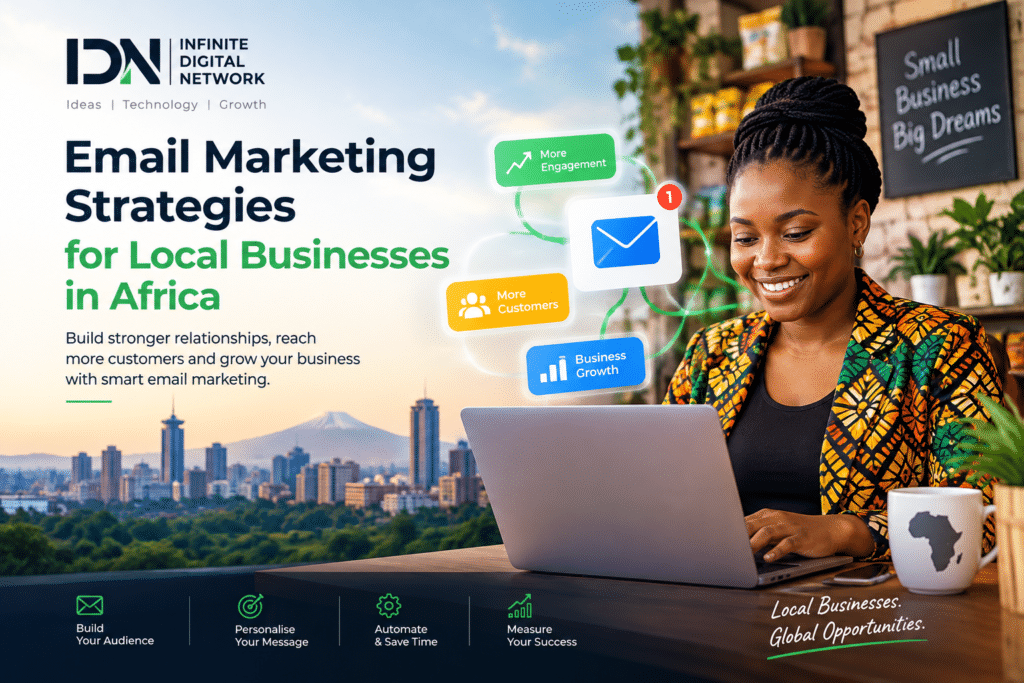
When people talk about digital marketing in Africa, the conversation usually goes straight to social media and WhatsApp. Email often gets forgotten. That is a mistake. Email marketing remains one of the most affordable and reliable ways for a local business to stay in touch with customers, drive repeat sales and build lasting relationships, and it does so on a channel you own, unlike social platforms where algorithms decide who sees your posts.

This guide covers the best email marketing strategies for local businesses in Africa, with practical steps you can start using this week, whether you run a shop in Kisumu, a salon in Kumasi or a consultancy in Kigali.
Why Email Marketing Still Works for African Businesses

  • You own your list. If a social account is suspended or reach drops, your email list stays with you.
  • It is low cost. Many email platforms offer free plans that are enough for a small business starting out.
  • It is personal and direct. An email lands in an inbox that the customer chose to share with you.
  • It supports every other channel. Email works alongside social media, SEO, WhatsApp and SMS.
  • Results are measurable. You can see who opened, clicked and bought.

Email also suits professionals, online shoppers, students, corporate buyers and diaspora customers, who often use email every day for work and transactions.

1. Choose the Right Email Marketing Platform

You do not need expensive software. Look for a tool that is easy to use, has a free or affordable plan, offers templates, automation and reporting, and sends well to inboxes. Popular options include Mailchimp, Brevo, MailerLite and Zoho Campaigns. Check pricing in your currency, as costs can rise quickly when your list grows, and make sure the platform supports mobile-friendly emails.

2. Build Your Email List the Right Way

A smaller list of interested people beats a large list of strangers. Effective ways to grow your list include:

  • Website sign-up forms. Place a simple form in your header, footer, blog posts and a pop-up that does not annoy visitors.
  • A lead magnet. Offer something useful in exchange for an email address, such as a discount code, a free guide, a checklist, a price list or a free consultation.
  • In-store and event sign-ups. Collect emails on a tablet, a QR code or a sign-up sheet at your premises, markets, trade fairs and workshops.
  • Social media and WhatsApp. Invite followers to join your newsletter for exclusive offers.
  • Checkout and booking forms. Add an optional tick box for customers to receive updates.

Never buy email lists. Purchased lists hurt your reputation, lead to spam complaints and often break data protection laws.

3. Get Permission and Stay Compliant

Data protection laws are now in place across much of the continent, including Kenya’s Data Protection Act, Nigeria’s Data Protection Act, South Africa’s POPIA and Ghana’s Data Protection Act. Details differ by country, so check the rules where your customers live. As good practice everywhere:

  • Ask for clear consent before adding anyone to your list
  • Explain what you will send and how often
  • Include your business name and contact details in every email
  • Add an easy, working unsubscribe link
  • Store customer data securely and only keep what you need

Compliance is not just legal protection. It builds trust, which is especially valuable in markets where many people are wary of spam and scams.

4. Segment Your Audience

Sending the same message to everyone wastes opportunities. Even simple segmentation improves results. You can group subscribers by:

  • Location, such as city or neighbourhood, for local offers and events
  • Customer type, such as new subscribers, first-time buyers, repeat customers or inactive contacts
  • Interests or purchase history, such as the products or services they have viewed or bought
  • Business customers versus individuals

A café, for example, might send lunch deals to office workers near the CBD and weekend brunch offers to families.

5. Write Subject Lines That Get Opened

Your subject line decides whether your email is read. Keep it clear, honest and short enough to display on a phone.

  • Be specific: “20% off all tyres until Friday” beats “Big sale”
  • Add the customer’s name where it feels natural
  • Create genuine urgency, such as a real deadline
  • Avoid spammy words and excessive capital letters or symbols
  • Test two versions and keep the one that performs better

Use the preview text, the short snippet shown after the subject line, to add more context.

6. Design Emails for Mobile and Low Data

Most people will read your email on a smartphone, possibly on a limited data bundle. Design accordingly:

  • Use a single-column layout that is easy to read on a small screen
  • Compress images and avoid heavy attachments
  • Write short paragraphs and use clear headings
  • Make buttons large enough to tap easily
  • Add alt text so the message still makes sense if images do not load
  • Put your most important message and call to action near the top

A lightweight email that loads quickly will outperform a beautiful but heavy one.

7. Write Content People Actually Want

Not every email should be a sales pitch. Mix useful and promotional content so subscribers look forward to hearing from you. Ideas include:

  • Special offers, new arrivals and seasonal promotions
  • Tips, how-to guides and answers to common questions
  • Customer stories and testimonials
  • Behind-the-scenes updates and company news
  • Local event invitations and community news
  • Reminders for appointments, renewals or restocks

Write in a warm, conversational tone. Use plain language and, where it suits your audience, local expressions or a mix of languages.

8. Set Up Simple Email Automation

Automation lets you send the right message at the right time without extra daily work. Start with these basics:

  • Welcome series. Introduce your business, share your best content and offer a first-purchase incentive.
  • Abandoned cart emails. Remind online shoppers about items they left behind.
  • Order confirmation and delivery updates. Reassure customers and reduce support questions.
  • Review requests. Ask for feedback a few days after purchase.
  • Win-back emails. Re-engage customers who have not bought in a while.
  • Birthday or anniversary offers. A small gesture that builds loyalty.

9. Combine Email With WhatsApp and SMS

In Africa, the strongest results often come from using channels together. Email is ideal for detailed content, receipts and longer offers. WhatsApp is great for quick conversations and customer service, and SMS reaches people with limited internet access. For example, you can send an email with a new offer, follow up with an SMS reminder before it ends, and let customers reply on WhatsApp to order. Always make sure customers have opted in to each channel.

10. Make Every Email Easy to Act On

Each email should have one clear goal and one main call to action, such as “Book now,” “Shop the offer” or “Reply to this email.” Include your phone number, WhatsApp link, address and payment options, including mobile money, so customers can respond immediately. Remove anything that distracts from the main action.

11. Send at Sensible Times and Frequency

There is no perfect schedule for every business. Start by sending once or twice a month, or weekly if you have plenty of valuable content, and adjust based on results. Consider when your customers are likely to check email, such as early morning, lunch breaks or evenings, and test different days. Consistency matters more than volume, because subscribers should know what to expect from you.

12. Track Results and Keep Improving

Review your reports after every campaign. Key metrics include:

  • Open rate: how many people opened the email
  • Click-through rate: how many clicked a link
  • Conversion rate: how many took the action you wanted
  • Unsubscribe and bounce rates: signs of list quality and relevance
  • Revenue per campaign: the real measure of success

Note that some email apps pre-load content, so open rates can be less reliable than they once were. Focus more on clicks, replies and sales. Test one change at a time, such as the subject line, send time or button text, and keep what works.

Common Email Marketing Mistakes to Avoid

  • Emailing people who never agreed to hear from you
  • Sending only sales messages with no value
  • Using unclear or misleading subject lines
  • Ignoring mobile users and sending heavy emails
  • Forgetting to clean your list of inactive or invalid addresses
  • Not testing, tracking or improving campaigns
  • Using a free personal email address, such as Gmail, as your sender instead of a business domain email

Final Thoughts

Email marketing may not be the loudest channel, but it is one of the most dependable for local businesses in Africa. Build your list with permission, segment your audience, write helpful mobile-friendly emails, automate the basics, and measure what happens. Combined with your website, SEO, social media and WhatsApp, email turns one-time buyers into loyal customers.

Grow Your Business With Infinite Digital Network

At Infinite Digital Networks, we help businesses design and run email campaigns, build high-converting websites and grow online through SEO, social media and digital strategy tailored to African markets. If you want help setting up email marketing that brings real customers and revenue, contact our team today for a free consultation.

Email: marketing@infiniteigitalnetwork.com

WhatsApp:+254798852545

Frequently Asked Questions

Is email marketing effective for small businesses in Africa?

Yes. It is low cost, reaches customers directly and works well alongside WhatsApp, SMS and social media, especially for repeat sales and customer retention.

How do I build an email list from scratch?

Offer a useful incentive such as a discount or free guide, add sign-up forms to your website and social media, and collect emails in person at your shop or events, always with permission.

Which email marketing tool is best for a local business?

Platforms such as Mailchimp, Brevo, MailerLite and Zoho Campaigns are popular. Choose one with a free or affordable plan, easy automation and mobile-friendly templates.

How often should I send marketing emails?

Most small businesses do well with one to four emails a month. Start modestly, watch your results and adjust based on subscriber response.

Do I need a business domain email to send campaigns?

It is strongly recommended. A branded address, such as info@yourbusiness.com, looks more professional, builds trust and helps your emails reach inboxes.

Leave a Reply

Your email address will not be published. Required fields are marked *

Commonly asked questions and answers

Phone:
+254 798 852545
Email:
info@infinitedigitalnetwork.com
marketing@infinitedigitalnetwork.com
What does your web design and development process include?
Our web design and development process includes discovery and strategy, custom UI/UX design, responsive front-end development, robust back-end integration, SEO optimization, quality assurance testing, and post-launch support—ensuring a high-performing, user-friendly website tailored to your business goals.
We work with businesses of all sizes—from startups and small enterprises to large corporations. At Infinite Digital Network, we tailor our digital marketing, web design, and AI-driven solutions to fit your unique goals, budget, and growth stage.
Yes, we specialize in modernizing and optimizing existing websites. Whether it’s a design refresh, performance upgrade, SEO enhancement, or migrating to a new platform, we carefully audit your current site and implement targeted improvements to boost functionality, user experience, and results—without disrupting your operations..
We use a modern, flexible tech stack tailored to your project’s needs. Our front-end development leverages HTML5, CSS3, JavaScript, React, and Vue.js, while back-end solutions include Node.js, PHP (Laravel), Python (Django/Flask), and WordPress for CMS-driven sites. For eCommerce, we work with Shopify, WooCommerce, and Magento. We also integrate AI tools, RESTful APIs, and cloud platforms (like AWS and Firebase) to ensure scalability, security, and performance.
Yes, we offer comprehensive post-launch support to ensure your website or digital solution continues to perform at its best. Our support includes technical maintenance, performance monitoring, security updates, content adjustments, bug fixes, and strategic optimization—so you can focus on your business while we keep your digital presence running smoothly and securely.

Newsletter subscribe!

Enter your email to unlock an exclusive 10% discount on professional website development tailored to your business needs.

Have more questions?

Let’s schedule a short call to discuss how we can work together and contribute to the success of your project or idea.