By Infinite Digital Network
When people talk about digital marketing in Africa, the conversation usually goes straight to social media and WhatsApp. Email often gets forgotten. That is a mistake. Email marketing remains one of the most affordable and reliable ways for a local business to stay in touch with customers, drive repeat sales and build lasting relationships, and it does so on a channel you own, unlike social platforms where algorithms decide who sees your posts.
This guide covers the best email marketing strategies for local businesses in Africa, with practical steps you can start using this week, whether you run a shop in Kisumu, a salon in Kumasi or a consultancy in Kigali.
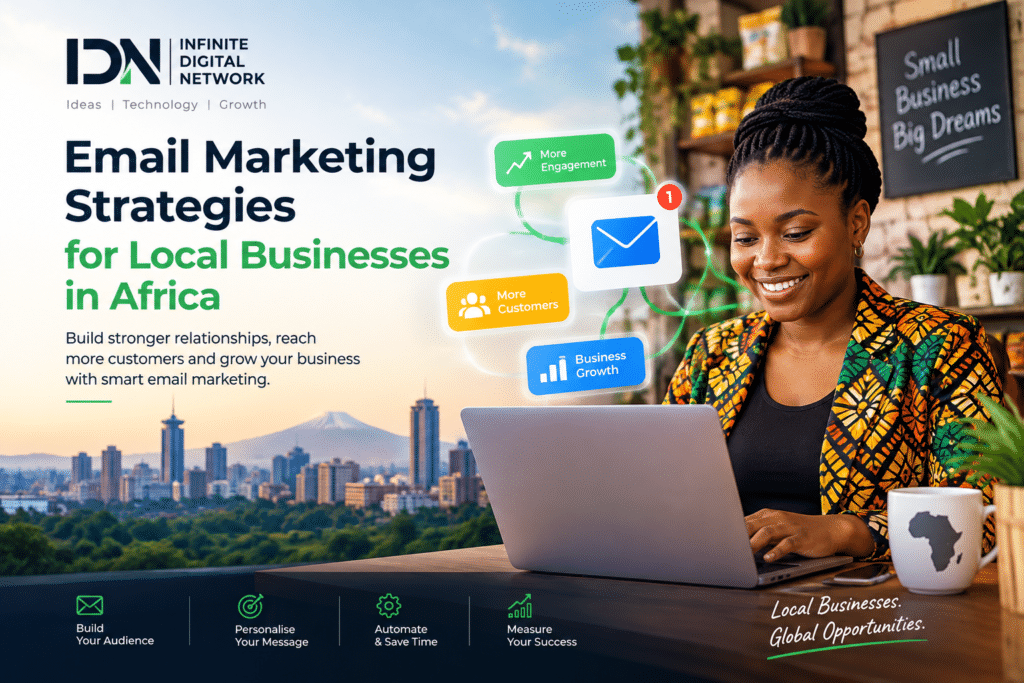
Email also suits professionals, online shoppers, students, corporate buyers and diaspora customers, who often use email every day for work and transactions.
You do not need expensive software. Look for a tool that is easy to use, has a free or affordable plan, offers templates, automation and reporting, and sends well to inboxes. Popular options include Mailchimp, Brevo, MailerLite and Zoho Campaigns. Check pricing in your currency, as costs can rise quickly when your list grows, and make sure the platform supports mobile-friendly emails.
A smaller list of interested people beats a large list of strangers. Effective ways to grow your list include:
Never buy email lists. Purchased lists hurt your reputation, lead to spam complaints and often break data protection laws.
Data protection laws are now in place across much of the continent, including Kenya’s Data Protection Act, Nigeria’s Data Protection Act, South Africa’s POPIA and Ghana’s Data Protection Act. Details differ by country, so check the rules where your customers live. As good practice everywhere:
Compliance is not just legal protection. It builds trust, which is especially valuable in markets where many people are wary of spam and scams.
Sending the same message to everyone wastes opportunities. Even simple segmentation improves results. You can group subscribers by:
A café, for example, might send lunch deals to office workers near the CBD and weekend brunch offers to families.
Your subject line decides whether your email is read. Keep it clear, honest and short enough to display on a phone.
Use the preview text, the short snippet shown after the subject line, to add more context.
Most people will read your email on a smartphone, possibly on a limited data bundle. Design accordingly:
A lightweight email that loads quickly will outperform a beautiful but heavy one.
Not every email should be a sales pitch. Mix useful and promotional content so subscribers look forward to hearing from you. Ideas include:
Write in a warm, conversational tone. Use plain language and, where it suits your audience, local expressions or a mix of languages.
Automation lets you send the right message at the right time without extra daily work. Start with these basics:
In Africa, the strongest results often come from using channels together. Email is ideal for detailed content, receipts and longer offers. WhatsApp is great for quick conversations and customer service, and SMS reaches people with limited internet access. For example, you can send an email with a new offer, follow up with an SMS reminder before it ends, and let customers reply on WhatsApp to order. Always make sure customers have opted in to each channel.
Each email should have one clear goal and one main call to action, such as “Book now,” “Shop the offer” or “Reply to this email.” Include your phone number, WhatsApp link, address and payment options, including mobile money, so customers can respond immediately. Remove anything that distracts from the main action.
There is no perfect schedule for every business. Start by sending once or twice a month, or weekly if you have plenty of valuable content, and adjust based on results. Consider when your customers are likely to check email, such as early morning, lunch breaks or evenings, and test different days. Consistency matters more than volume, because subscribers should know what to expect from you.
Review your reports after every campaign. Key metrics include:
Note that some email apps pre-load content, so open rates can be less reliable than they once were. Focus more on clicks, replies and sales. Test one change at a time, such as the subject line, send time or button text, and keep what works.
Email marketing may not be the loudest channel, but it is one of the most dependable for local businesses in Africa. Build your list with permission, segment your audience, write helpful mobile-friendly emails, automate the basics, and measure what happens. Combined with your website, SEO, social media and WhatsApp, email turns one-time buyers into loyal customers.
At Infinite Digital Networks, we help businesses design and run email campaigns, build high-converting websites and grow online through SEO, social media and digital strategy tailored to African markets. If you want help setting up email marketing that brings real customers and revenue, contact our team today for a free consultation.
Email: marketing@infiniteigitalnetwork.com
WhatsApp:+254798852545
Is email marketing effective for small businesses in Africa?
Yes. It is low cost, reaches customers directly and works well alongside WhatsApp, SMS and social media, especially for repeat sales and customer retention.
How do I build an email list from scratch?
Offer a useful incentive such as a discount or free guide, add sign-up forms to your website and social media, and collect emails in person at your shop or events, always with permission.
Which email marketing tool is best for a local business?
Platforms such as Mailchimp, Brevo, MailerLite and Zoho Campaigns are popular. Choose one with a free or affordable plan, easy automation and mobile-friendly templates.
How often should I send marketing emails?
Most small businesses do well with one to four emails a month. Start modestly, watch your results and adjust based on subscriber response.
Do I need a business domain email to send campaigns?
It is strongly recommended. A branded address, such as info@yourbusiness.com, looks more professional, builds trust and helps your emails reach inboxes.